
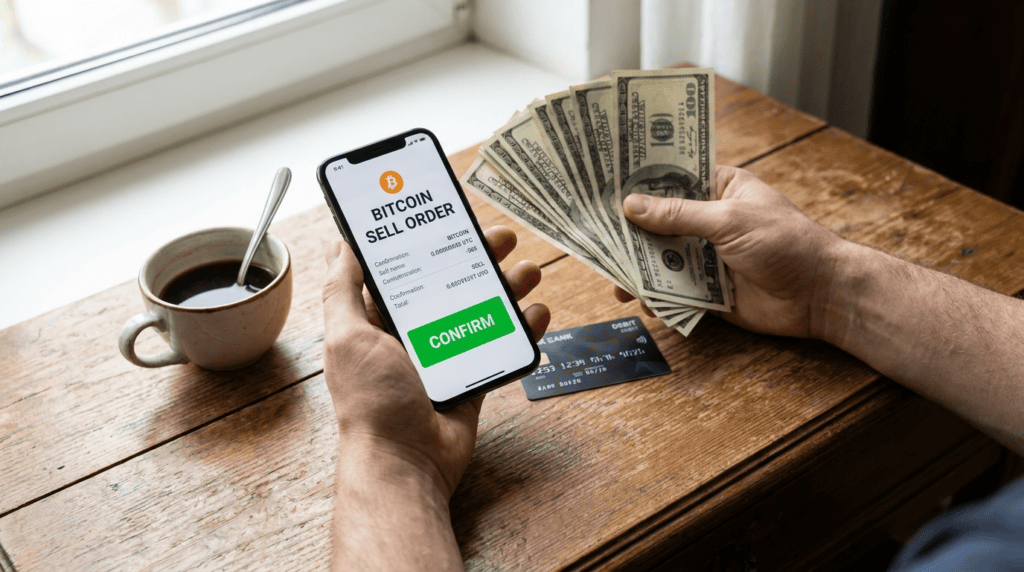
Can you cash out bitcoin for real money? Yes, and the sale itself takes seconds. The slow part is moving those dollars from the platform to a bank account you control, and that leg is where the fees and the holds live.
Four routes work today: sell on an exchange and withdraw, trade peer to peer, use a bitcoin ATM, or spend through a crypto debit card. All four end in the same dollar conversion and differ in who takes a cut and how long you wait.
The exchange route: sell first, withdraw second
On a centralized exchange, cashing out is two separate actions. You sell bitcoin into a cash balance on Coinbase or another exchange, then you withdraw that balance to a linked bank account or card. The sell settles instantly. The withdrawal follows its own clock.
The sell carries the trading cost. Coinbase builds a spread into the quoted price on simple sell orders and shows it on the preview screen next to any flat fee. Kraken lists fees per withdrawal method instead. The number on the preview screen is the cost you actually pay.
The withdrawal is where the days go. Coinbase says ACH typically takes 3 to 5 business days after a sell or withdrawal. Kraken’s ACH withdrawals are free and quoted at 0 to 2 business days.
Video: Cyber Scrilla
Four routes side by side: fees and timing
The table uses only figures printed on the operators’ own pages on 29 September 2026. Where a page shows the fee only at checkout, the cell says so instead of guessing.
| Route | What it costs | Time until you hold dollars |
|---|---|---|
| Coinbase sell plus ACH withdrawal | Spread plus Coinbase fee, shown on the preview screen | 3 to 5 business days for the ACH leg |
| Coinbase instant cashout (card or RTP bank) | Standard transaction fees, shown at checkout | About 30 minutes, up to 24 hours |
| Kraken ACH withdrawal | Free | 0 to 2 business days, 2pm EST cutoff |
| Kraken FedWire | 4 USD | 0 to 1 business days |
| Kraken RTP instant transfer | 1.5 percent, 50 USD maximum | Near instant |
| Kraken SWIFT (international) | 14 USD | 1 to 5 business days |
| Bisq peer to peer | 1.3 percent combined trade fee when paid in BTC | Buyer’s payment method, then escrow release |
| Bitcoin ATM sell | Operator markup, displayed on the machine before you confirm | Cash during the same visit |
| Coinbase Card spend | No transaction fee, spread on the sale, possible ATM operator fee | Instant at the point of sale |
Sources: Coinbase Help, Kraken Support and the Bisq Wiki, read 29 September 2026. Fees change; the checkout screen overrides this table.
Peer to peer: escrow does the trust work
A peer to peer trade removes the exchange but keeps the process. On Bisq, the seller locks the bitcoin in a multisig escrow before the buyer sends dollars, and releases it after confirming the payment landed. You get paid by the method the buyer chose, at that method’s speed.
The trade fee is 1.3 percent when paid in BTC, split 0.15 percent maker and 1.15 percent taker. Disputes have a process, and it is slow: Bisq gives mediators up to 48 hours and arbitrators up to 5 days to respond. P2P buys you privacy. It rarely buys you speed.
ATMs and debit cards: cash today, priced for it
A bitcoin ATM that supports selling pays out paper cash during the same visit. The operator sets its own markup and shows it on screen before you confirm. None of the large US operators publishes a fixed sell fee online, so check the machine’s quote against an exchange price on your phone first.
A crypto debit card skips the bank leg entirely. Coinbase Card charges no transaction fee to spend, but Coinbase sells the crypto at that moment with a spread included, and ATM operators may add their own fee. You are cashing out one purchase at a time, at that second’s spot price.
Why cashing out takes longer than buying in
Buying feels instant because the platform fronts you the asset while your deposit clears. Cashing out reverses the risk: the platform is now sending money out, so it waits for incoming funds to settle. Kraken holds withdrawals 72 hours after ACH, PayPal or card purchases, and 7 days after an ACH deposit through Plaid.
Speed exists at a price. Kraken’s real time payments withdrawal is near instant at 1.5 percent, capped at 50 dollars, against a free ACH that takes up to two business days. Coinbase’s instant cashout to a card or an RTP bank typically lands in about 30 minutes and can take up to 24 hours.
Stress adds a third clock. In a crash your sell can clear while your withdrawal sits in a queue, which is why exchanges halt withdrawals during a crash.
Coins on a hardware wallet add one more leg: an on-chain transfer to the exchange, with a network fee and confirmations before the sell button appears. That is where the hot wallet versus cold wallet choice shows its cost, and where a properly stored seed phrase matters more than any fee table.
The last cost arrives at tax time. The IRS treats digital assets as property, so selling bitcoin for dollars is a disposal you answer Yes to on Form 1040 and report. What you owe depends on your cost basis and situation, a question for a tax professional.
Frequently asked questions
How long does it take to cash out bitcoin to a bank account?
The sell is immediate. The bank transfer depends on the rail: Coinbase quotes 3 to 5 business days for ACH, Kraken quotes 0 to 2 business days for ACH and 0 to 1 for a FedWire, and instant options exist at a higher fee. Weekends and bank holidays do not count.
Is there a fee to sell bitcoin for cash?
Always, though it is not always labeled a fee. Exchanges build a spread into the sale price and may add a withdrawal fee, Bisq charges 1.3 percent of the trade, and ATM operators set a markup they show on screen. The preview screen is the only honest number.
Do I pay tax when I cash out bitcoin?
The IRS classifies digital assets as property, so selling for dollars is a reportable disposal and requires a Yes on the digital assets question of Form 1040. Whether you owe anything depends on your cost basis and holding period. Ask a tax professional; this article is general information only.

Charles Benkovich is the Crypto Editor at Hold Hub. He covers Bitcoin, Ethereum, XRP, and macro-driven market analysis with a focus on on-chain data over price speculation. His editorial standard: claims are sourced or labeled as analysis, and the site takes no payment to cover any project.