
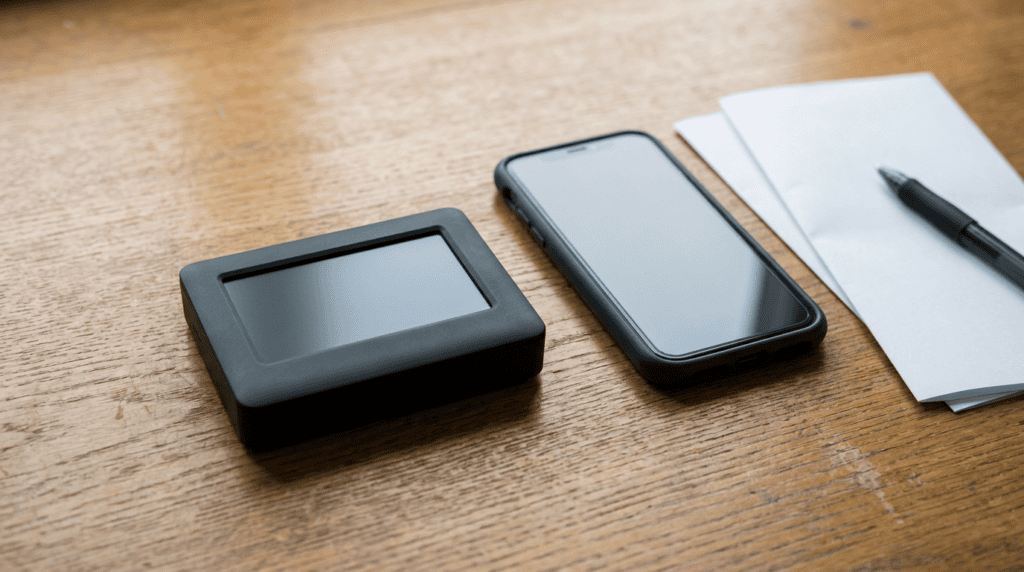
A hot wallet keeps your private keys on a device connected to the internet. A cold wallet keeps them on something that is not. The right choice depends on how much you hold, how often you move it, and which failure you are more likely to survive.
Most people asking this question are really asking a different one: how much inconvenience is my balance worth?
What each setup actually defends against
A hot wallet protects nothing from a compromised device. If malware reads your clipboard or a malicious approval drains your token allowances, the keys are right there. Browser extension wallets and exchange-linked apps sit in this category.
A cold wallet removes that attack surface. Signing happens on hardware that never exposes the key, so a compromised laptop can broadcast a transaction only if you physically confirm it.
What cold storage does not protect against is you. Lost recovery phrases, damaged backups and mistyped words account for a large share of permanently inaccessible crypto. The mechanics of that recovery phrase are covered in our explainer on what a seed phrase is.
The amount test
Ask what balance would genuinely hurt to lose. Not annoy you, hurt you.
Anything above that line belongs in cold storage. Anything below it can sit hot, because the convenience is worth more than the marginal risk.
That line is personal and it moves. Someone holding a few hundred dollars of a volatile altcoin has a different answer than someone holding a retirement position.
The frequency test
Hardware wallets punish frequent activity. Every transaction means finding the device, connecting it, and confirming on a small screen.
If you trade weekly, interact with DeFi protocols, or mint regularly, a hot wallet is the practical tool. Fighting that reality usually ends with people leaving the hardware wallet in a drawer and using the hot wallet for everything anyway.
If you buy and hold for years, the friction costs you almost nothing. That is the profile cold storage was built for.
Why the honest answer is usually both
Split by function rather than picking a side. A cold wallet holds the long-term position and never signs anything experimental. A hot wallet holds a working balance you would accept losing.
Institutions do roughly this, with most assets in deep cold storage and a smaller operational tranche free to move. Our breakdown of what crypto custody actually means covers how that structure works at scale.
Keep the two separate. Moving funds out of cold storage before you use them is the point of the arrangement.
Where the trade-off gets misread
Buying a hardware wallet does not make you secure if the recovery phrase is photographed on your phone. The device only moves the weak point, it does not remove it. We covered the storage mistakes people repeat in our piece on where you should never keep a seed phrase.
The other misread runs the opposite way. People assume a hot wallet means constant danger, then keep everything on an exchange instead, which is a different risk entirely because those keys are not yours.
Common questions on wallet choice
Is a hardware wallet worth it for a small balance?
That depends on whether you expect the balance to grow and how often you transact. For a small, actively traded position the friction often outweighs the benefit. For a small position you plan to hold untouched for years, the calculation changes.
Can a cold wallet be hacked remotely?
Not while it stays offline, because there is no network path to the keys. The realistic attacks are physical theft, supply chain tampering on a device bought secondhand, and tricking you into signing a malicious transaction yourself.
What happens to a cold wallet if the manufacturer shuts down?
Your funds live on the blockchain, not on the device. With the recovery phrase you can restore the same accounts in other compatible wallet software.

Charles Benkovich is the Crypto Editor at Hold Hub. He covers Bitcoin, Ethereum, XRP, and macro-driven market analysis with a focus on on-chain data over price speculation. His editorial standard: claims are sourced or labeled as analysis, and the site takes no payment to cover any project.