
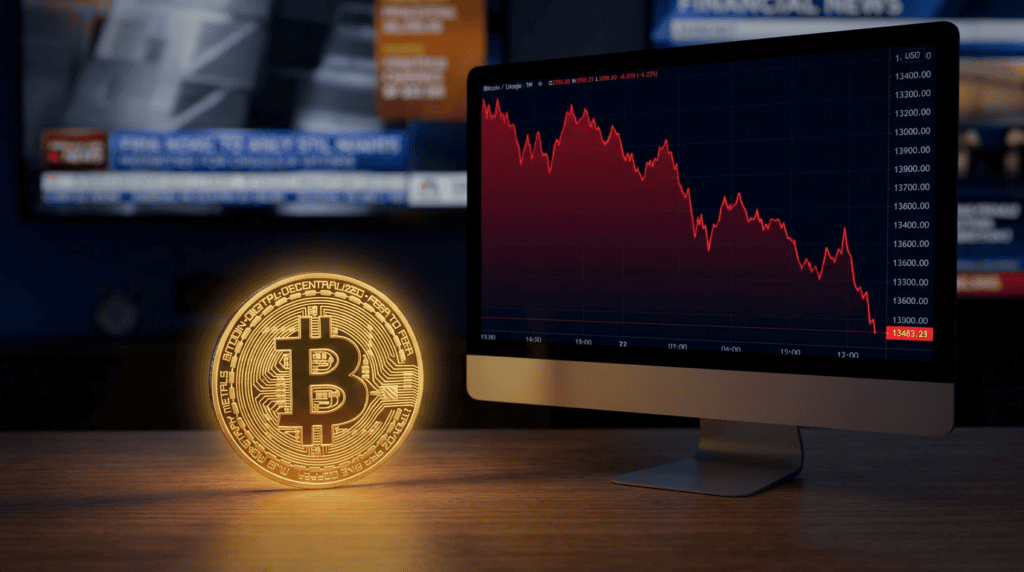
Bitcoin can crash hard while the S&P 500 barely moves because they are structurally different assets. Stocks trade six and a half hours a day with circuit breakers, market makers, and earnings that anchor valuation. Bitcoin trades 24/7 on thin order books spread across dozens of exchanges, with no backstop and no trading halt.
That gap matters when you are trying to tell whether a crypto drawdown warns about your whole portfolio or stays contained to crypto. Usually it stays contained, but not always.
Leverage and Liquidations Amplify Every Move
A large share of crypto trading runs through derivatives, futures and perpetual swaps where traders borrow to open bigger positions than their cash allows. When price drops even slightly, exchanges automatically close out over-leveraged positions.
Each forced liquidation adds sell pressure, which triggers the next batch. This cascade can knock ten percent off Bitcoin in hours with no new information involved. The real reasons behind sudden Bitcoin crashes almost always trace back to this leverage unwind. Stocks have margin calls too, but circuit breakers and lower typical leverage keep the effect contained.
Bitcoin Has No Circuit Breakers or Trading Halts
The NYSE and Nasdaq pause trading automatically if the market falls fast enough, giving buyers time to reassess before panic compounds. Crypto exchanges have no equivalent and never close.
A sharp move at 3am Eastern, when US equity desks sleep and liquidity thins out, can push Bitcoin several points in either direction before most traders notice. This is part of why Bitcoin stays far more volatile than stocks even in calm macro periods.
ETF Flows Move Bitcoin Independently of Equities
Spot Bitcoin ETFs opened the asset to institutional and retail money that flows in and out based on crypto-specific sentiment, not S&P 500 sentiment. A week of heavy ETF outflows can pressure Bitcoin while equity fund flows stay calm.
These flows cut both ways. Strong inflow days have pushed Bitcoin higher on sessions when stocks traded flat, the same mechanism behind days when Bitcoin rallies for reasons unrelated to the broader market.
Regulatory Headlines Hit Crypto Alone
An SEC enforcement action, an exchange delisting, a country restricting crypto trading, or a custodian pausing withdrawals shocks crypto markets specifically. None of these touch earnings, interest rates, or GDP, so equities have no reason to react.
A regulatory scare in crypto rarely spills into banking or tech stocks, unless a major crypto-linked company also carries significant equity market exposure.
When Bitcoin and Stocks Actually Move Together
The decoupling story breaks down during macro shocks. A surprise Fed rate decision, inflation data far outside expectations, or a systemic liquidity crunch gets both risk assets sold at once.
In those windows, Bitcoin behaves like a high-beta tech stock, often falling faster than the Nasdaq on the way down. The correlation is not fixed. It rises during broad risk-off events and fades back toward zero during crypto-specific news cycles.
Risk Note
Bitcoin remains highly volatile, with a shorter track record than equities and no earnings or cash flow to anchor its valuation. Nothing here is financial advice or a price prediction.
Frequently Asked Questions
Does Bitcoin always crash when stocks fall?
No. Bitcoin tracks equities closely mainly during broad macro shocks like surprise rate decisions or systemic liquidity events. Outside those windows, leverage unwinds, ETF flows, and regulatory news drive its price independently of stocks.
Why does Bitcoin drop so much faster than stocks in a single day?
Bitcoin trades around the clock with no circuit breakers, and much of its volume comes from leveraged derivatives. When price starts falling, automatic liquidations add sell pressure on top of the initial move, something equity markets are structurally built to slow down.
Are Bitcoin ETF outflows a reliable crash signal?
Heavy, sustained outflows have coincided with price weakness, but a single day of outflows is not a dependable predictor. Treat flows as one input among several, not a standalone signal.

Charles Benkovich is the Crypto Editor at Hold Hub. He covers Bitcoin, Ethereum, XRP, and macro-driven market analysis with a focus on on-chain data over price speculation. His editorial standard: claims are sourced or labeled as analysis, and the site takes no payment to cover any project.