
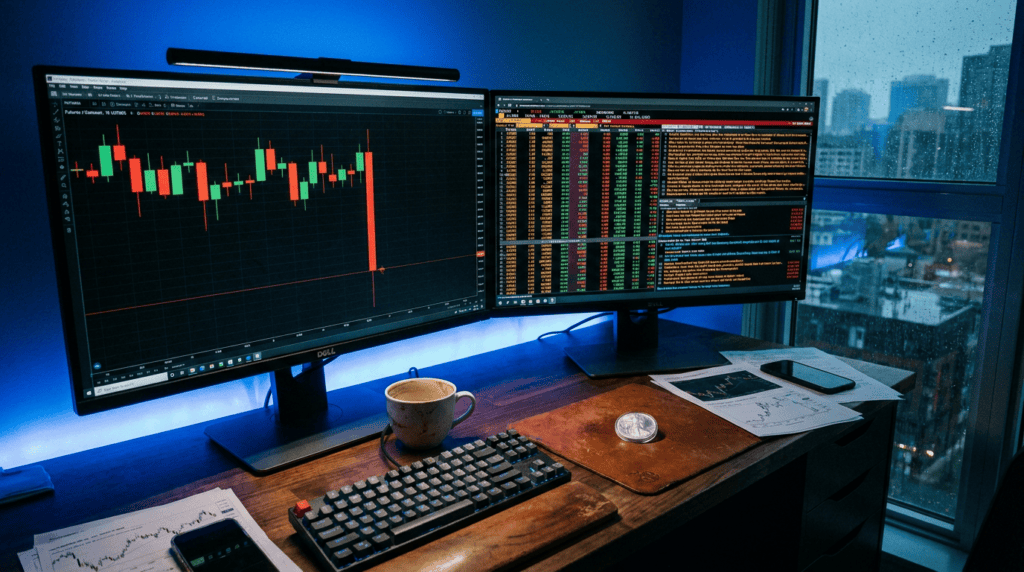
An XRP liquidation imbalance means exchanges force-closed far more margin positions on one side, longs or shorts, than on the other in a set window. It shows where borrowed money was crowded. It does not tell you where XRP goes next.
Read it as a record of who was wrong on borrowed money. The imbalance shows up after the price has already moved.
What a liquidation imbalance actually counts
A liquidation is an exchange closing a margin position because the trader’s collateral can no longer cover the loss. On Kraken Derivatives, it triggers when portfolio value falls below maintenance margin at the mark price, with no margin call or warning first.
The direction matters. A liquidated long is closed with a forced sell. A liquidated short is closed with a forced buy. So a long-heavy imbalance means forced selling hit a market that was already falling.
Trackers add up these forced closes per side and per window, usually one hour, four hours or 24 hours, across the exchanges they can see. An exchange that does not publish its feed is not in the total.
Video: Coin Bureau
Why the imbalance is a symptom of crowding, not a cause of direction
Liquidations need a price move to start. Something else pushes XRP first: a Bitcoin drop, a headline, a large spot seller. Only then do the positions sitting closest to that move get closed.
What makes one side lopsided is how crowded it was. Binance’s long/short account ratio for XRPUSDT showed about 70% of accounts net long on each daily reading from 25 to 27 September 2026.
When that many traders lean one way, a small dip reaches a lot of liquidation prices at once.
That is the cascade. Each forced sell pushes the mark price toward the next cluster of stops, which is why altcoins with thinner order books crash harder than Bitcoin when margin positions unwind.
A cascade can also outrun the exchange’s own backstop. Binance describes auto-deleveraging as the final step, used only when its insurance fund cannot absorb a bankrupt position, and it closes profitable traders on the other side to cover the gap.
What the numbers looked like on 27 September 2026
The last 100 filled XRP-USDT perpetual liquidations on OKX, covering 20:42 UTC on 26 September to 12:07 UTC on 27 September, split 60 to 40 in favour of longs by dollar value. On its own, that reads like a bearish flush.
Scale says otherwise. Those 100 orders totalled about $584,000, roughly 0.07% of the open interest on Binance and Bybit combined, read about 20 minutes after the window closed.
Funding was close to zero on both. XRP barely moved on the day.
| Metric | Reading | What it tells you |
|---|---|---|
| OKX long liquidations (last 100 fills) | 68 orders, about $350,000 | Forced selling, the larger side |
| OKX short liquidations (last 100 fills) | 32 orders, about $234,000 | Forced buying, the smaller side |
| Binance XRPUSDT open interest | 330.9 million XRP, about $509 million | Margin positions still open |
| Bybit XRPUSDT open interest | $336 million | Margin positions still open |
| Funding rate, Binance / Bybit | +0.00005% / -0.0043% | Neither side paying up to stay in |
| Binance accounts net long | 70.4% | Crowding by head count, not by size |
| XRP 24-hour change (CoinGecko) | -0.07% at $1.54 | No real move behind the imbalance |
Source: public APIs of OKX (liquidation-orders), Binance (premiumIndex, openInterest, globalLongShortAccountRatio), Bybit (v5 tickers) and CoinGecko, read 27 September 2026.
Three ways traders misread a liquidation headline
The first is treating a dollar total as big without a denominator. A few hundred thousand in forced closes against more than $800 million in open interest is noise, whatever the headline ratio.
The second is reading a long-heavy print as a signal to short. A large long flush often clears the crowded side, and the forced selling ends with it.
That pattern sits behind many of the moves where XRP drops after every rally and then stabilises.
The third is trusting the account ratio as a position ratio. Seventy percent of accounts long can coexist with a few large short positions that outweigh them. The ratio counts traders, not money.
What to check before you act on an imbalance
Pair it with open interest. If open interest falls sharply alongside the liquidations, the crowded bets were flushed. If it keeps rising, new margin bets are replacing what was lost and the next cascade is being built.
Then check funding and spot volume. Heavy positive funding means longs are paying to stay in, and a move on thin spot volume is mostly derivatives.
The same logic applies to reading what moves the XRP price today: find out who is forced to trade before asking who wants to.
Frequently asked questions
Is a long liquidation imbalance bearish for XRP?
It is bearish for the minutes it lasts, because each liquidated long is a forced sell. Afterwards it often means the crowded side has been cleared. Check open interest: if it fell too, the bets are gone; if it rose, traders are rebuilding them.
Where can I see XRP liquidation data?
OKX publishes recent liquidation orders through a public API, and aggregator dashboards combine several venues. Each aggregator covers only the exchanges it can read, so totals differ between sites. Compare any figure with open interest on the same venues before calling it large.
Can a short squeeze push XRP up on its own?
Only briefly. Forced short covering adds buying for as long as liquidations last. Without spot demand behind it, the price usually gives the move back once the shorts are gone, so check whether spot volume rose with the candle.

Charles Benkovich is the Crypto Editor at Hold Hub. He covers Bitcoin, Ethereum, XRP, and macro-driven market analysis with a focus on on-chain data over price speculation. His editorial standard: claims are sourced or labeled as analysis, and the site takes no payment to cover any project.