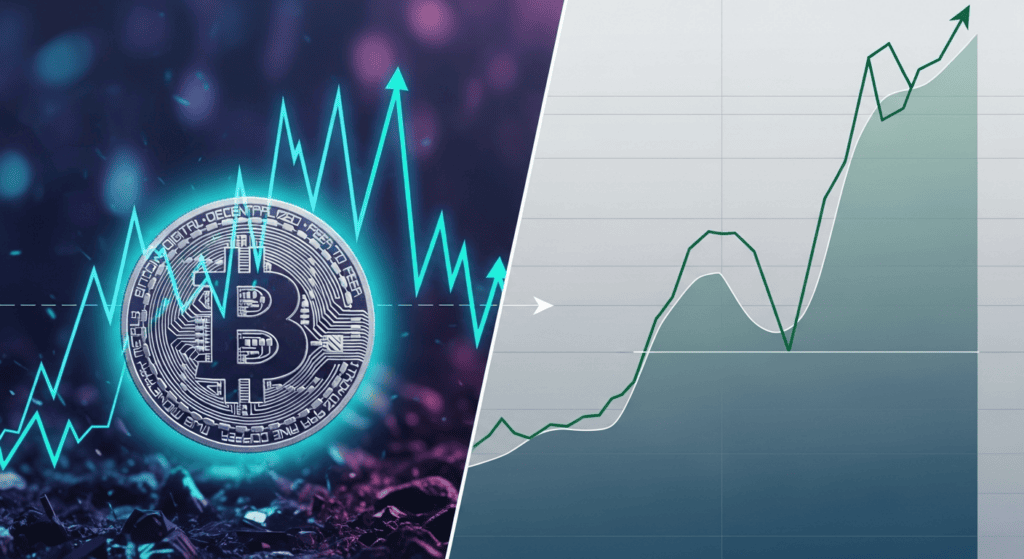
Bitcoin is more volatile than stocks mainly because its order books are thinner, it trades 24 hours a day with no circuit breakers, and leveraged positions can cascade into sharp moves in either direction. Equities trade on deeper, more regulated markets with built-in pauses that Bitcoin simply does not have.
None of this makes Bitcoin inherently good or bad as an asset. It just means the mechanics behind its price behave very differently from a share of stock.
Thin order books amplify every move
Even at Bitcoin’s size, its order book depth is still shallower than major stock indexes, meaning a single large trade can move the price more than an equivalent trade would move a blue-chip stock. Liquidity has improved over the years, but it still lags far behind equity markets.
This is one of the same structural forces behind sharp single-day crashes, which our explainer on why Bitcoin is dropping right now breaks down from the downside specifically.
Trading never stops, so pressure never pauses
Stock exchanges close overnight and on weekends, giving markets a built-in cooling-off period after major news. Bitcoin trades continuously, so a reaction to breaking news can compound for hours without any pause for the market to digest it.
Circuit breakers on stock exchanges also halt trading temporarily during extreme moves, a safety mechanism crypto markets do not have in any standardized form.
Leverage cuts both ways, hard
Crypto exchanges have historically offered far higher leverage than regulated equity markets, and that leverage means routine price dips can trigger cascading liquidations that push the move much further than the initial trigger warranted. This mechanic works identically on the way up, which is part of why Bitcoin rallies can also move so fast.
Equities have leverage too, through margin trading and options, but with tighter limits and more oversight than most crypto derivatives platforms.
A younger, less mature market
Stock markets have over a century of institutional participation, valuation frameworks, and regulatory infrastructure behind them. Bitcoin, by comparison, is still a relatively young asset class without agreed-upon valuation models, which leaves more room for sentiment-driven swings.
As more institutional capital enters through regulated products, some of this volatility gap has narrowed, though it remains significant compared to established equities.
What this means if you are holding Bitcoin
Expect drawdowns and rallies that would be considered extreme in equity markets to be fairly routine for Bitcoin. Position sizing matters more here precisely because the swings are larger, and treating Bitcoin like a stable, low-volatility asset is a mismatch with how it actually behaves.
Nothing here is financial advice or a prediction of future price behavior. For more on how a specific rally often forms, see why Bitcoin is going up today, and for a broader look at portfolio risk, our piece on whether XRP is a good investment covers similar volatility tradeoffs in another major asset.
Frequently asked questions
Is Bitcoin always more volatile than stocks?
Generally yes, though the gap narrows during calm periods and widens sharply during stress events. Bitcoin’s structural factors, thin liquidity and continuous trading, mean it rarely matches equity-level stability for long.
Does higher volatility mean Bitcoin is a worse investment than stocks?
Not inherently. Volatility is a risk characteristic, not a verdict on quality. It simply means position sizing and risk tolerance matter more than they would with a lower-volatility asset.
Will Bitcoin’s volatility decrease over time?
It may, as liquidity deepens and more regulated products enter the market, though this is not guaranteed. Its volatility has already declined somewhat compared to its earliest years.

Charles Benkovich is the Crypto Editor at Hold Hub. He covers Bitcoin, Ethereum, XRP, and macro-driven market analysis with a focus on on-chain data over price speculation. His editorial standard: claims are sourced or labeled as analysis, and the site takes no payment to cover any project.