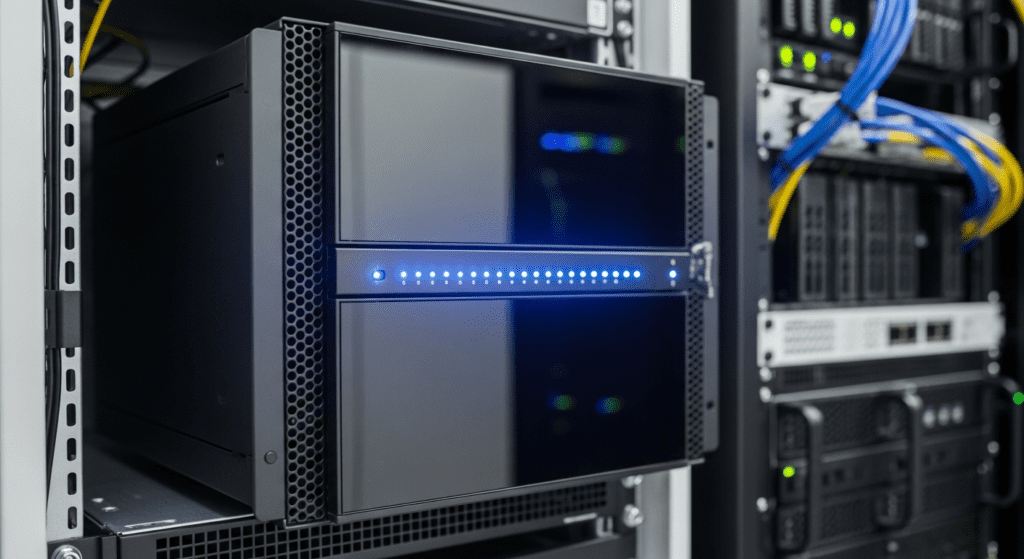
NetApp (Nasdaq: NTAP) builds enterprise data storage systems and the software that manages them across on-premise data centers and hybrid cloud environments. Its best-known product is the ONTAP operating system, which runs the data pipelines behind enterprise AI workloads, including deployments on the NVIDIA DGX SuperPOD reference architecture. At $159.71 per share (June 18 close), NTAP trades at a forward P/E of 16.2x and an EV/EBITDA of 16.3x, the lowest of any name in this AI storage peer group, while generating a free cash flow yield of 4.14%, the highest in the group. If you are looking for best AI storage stocks at a value price, NTAP makes a compelling case. The question is whether slow revenue growth justifies the cheap multiple or signals something worse.
What NetApp Actually Does
NetApp sells three things: all-flash storage arrays (the AFF product line), hybrid cloud management software (ONTAP), and object storage for unstructured data (StorageGRID). The company also runs Spot by NetApp, a cloud cost optimization layer that sits on top of AWS, Azure, and Google Cloud.
Unlike pure-play hardware vendors, NetApp makes most of its money on software and subscription services attached to storage systems sold years ago. That recurring revenue mix is what drives the 70.7% gross margin, the highest in the peer group. For context, Dell’s OEM hardware business operates at 19% gross margins. NetApp’s gross margin sits closer to a SaaS company than a storage box seller.
The AI angle is concrete. NetApp is a validated reference architecture partner for NVIDIA DGX SuperPOD, the pre-engineered AI cluster system that enterprises buy when they want an on-premises GPU cluster without starting from scratch. When a Fortune 500 company stands up a DGX SuperPOD, NetApp ONTAP is often the shared storage layer that all the GPUs talk to simultaneously. That certification matters because it puts NetApp inside the procurement checklist for any serious enterprise AI build.
What ONTAP Is and Why It Keeps Coming Up
ONTAP is NetApp’s data management operating system. Think of it as the brain that sits between your physical storage hardware and everything that needs to read or write data, whether that is an on-premise server farm, a cloud workload running on AWS, or a GPU training job running through an NVIDIA DGX cluster. ONTAP handles data tiering (moving hot data to fast flash, cold data to cheaper storage automatically), snapshot and replication for disaster recovery, and NFS/SMB file protocol support that AI training jobs depend on. It runs on NetApp’s own hardware and, through ONTAP Select, on commodity servers. What makes ONTAP strategically important is that once a company’s storage is managed by ONTAP, migrating away is a multi-year project. The lock-in is real, and it is why NTAP’s recurring software revenue holds up even in slow-growth quarters. Zacks noted in June 2026 that investor search interest in NTAP has been climbing, a sign that the value story is getting attention even as the stock sits well below its 52-week high.
For a deeper look at why storage performance is inseparable from AI hardware demand, see our explainer on HBM and what it means for storage demand.
NTAP Financials: The Value Case in Plain Numbers
| Metric | NTAP | Peer Group Range |
|---|---|---|
| Price (Jun 18, 2026) | $159.71 | n/a |
| Market Cap | $31.3B | $3.5B – $1.28T |
| Forward P/E | 16.2x | 9.9x – 50.3x |
| EV/EBITDA | 16.3x | 20.1x – 90.4x |
| Gross Margin | 70.7% | 19.2% – 68.0% |
| FCF Yield | 4.14% | Highest in group |
| Revenue Growth (YoY) | +12.5% | Slowest in group |
| Short Ratio | 6.06 days | Highest in group |
| Analyst Target | $171.75 | 7.5% upside |
| 52-Week Range | $93.69 – $192.83 | n/a |
NTAP is the cheapest name on both forward P/E and EV/EBITDA across all ten AI storage names tracked in this series. Its FCF yield of 4.14% is real, generated cash, not a trailing-multiple illusion. The gross margin of 70.7% is the best in the group, ahead of even Credo Technology’s 68.0%. And the stock is trading at $159.71, roughly 17% below its 52-week high of $192.83, at a time when most peers are at or near all-time highs.
The one clear weakness is revenue growth. At 12.5% year-over-year, NTAP grows more slowly than any other company in this group. Seagate grew 44%. Dell grew 87%. SanDisk grew 251%. For growth-oriented investors chasing the AI memory wave, NTAP is the wrong vehicle. For value-oriented investors who want AI infrastructure exposure with actual earnings and cash flow behind it, the setup looks different.
NetApp vs. Everpure: The All-Flash Rivalry
The most direct competitive comparison for NTAP in the all-flash storage segment is Everpure (NYSE: P), formerly known as Pure Storage. Everpure rebranded in March 2026 after announcing the change in February of that year and continues to trade publicly as an independent all-flash specialist.
The fundamental difference between the two: Everpure is an all-flash-only vendor with no hybrid cloud management layer equivalent to ONTAP. NetApp is a hybrid, running ONTAP across flash, spinning disk, and cloud simultaneously. Everpure’s Evergreen//One service model charges customers on a subscription per terabyte, which is elegant but limits the platform stickiness ONTAP achieves by sitting between every layer of the stack.
For a detailed breakdown of how Everpure approaches the market, see our full Pure Storage vs NetApp analysis.
Against Dell’s PowerStore (which competes directly in all-flash arrays) and against AWS S3 on object storage, NetApp’s edge is ONTAP portability. An enterprise running ONTAP on-prem can extend the same storage policies to AWS or Azure without rewriting their data pipeline. That matters a great deal for AI teams who do not want to vendor-lock their training data to a hyperscaler.
The Dividend Question
NetApp has historically paid a dividend, and the company has maintained a shareholder return program that includes both dividends and buybacks. The current dividend yield does not appear in yfinance data at the time of writing. Before making any investment decision based on dividend income, check the latest declared dividend on NetApp’s investor relations page or your brokerage platform. The FCF yield of 4.14% does confirm that NetApp generates enough free cash to sustain meaningful capital returns, whatever the exact payout is at any given time.
Bull Case: The Short-Squeeze Setup
The short ratio on NTAP is 6.06 days, the highest among all ten stocks in this group. That means short sellers have built a meaningful position betting against the stock. Short ratios above five days typically signal significant pessimism. They also create mechanical fuel for a squeeze if sentiment shifts.
The scenario: NTAP beats consensus on its next earnings report. Short sellers start covering. The stock, already down from $192 to $159, starts moving. Analyst targets at $171.75 suddenly look conservative. The squeeze builds its own momentum.
The fundamental case supports the bull scenario too. A forward P/E of 16.2x on a business with 70.7% gross margins and $1.3 billion in annual free cash flow is not a stretched valuation. If NTAP simply delivers steady results and enterprise AI infrastructure spending continues to grow, the multiple should expand toward peers rather than compress further. The DGX SuperPOD partnership gives NTAP a direct line into every serious enterprise AI deployment, and that pipeline has not yet shown up fully in the revenue growth numbers.
Bear Case: Revenue Growth Is the Problem
Revenue growing at 12.5% per year while the rest of the AI storage sector compounds at 45-250% is a real concern. ONTAP’s hybrid model means NetApp serves customers who are not fully committed to all-flash or cloud-native architectures, which may indicate a structurally slower-moving customer base rather than just a temporary lag.
The MACD on NTAP is in bearish territory as of mid-June 2026, with the signal line rolling over. The stock is trading near the midpoint of its Bollinger Band range, suggesting neither momentum buyers nor value buyers are stepping in forcefully. On a technical basis, NTAP is coasting, not rallying.
Competitive pressure is building on two fronts. On the all-flash side, Everpure and Dell’s PowerStore are taking share with simpler, cloud-native platforms. On the object storage side, AWS S3 and Azure Blob have essentially commoditized cold storage at a price NetApp’s StorageGRID cannot easily beat for purely cloud-native workloads. NTAP’s moat is real but narrower than it was five years ago.
Is NTAP a Good Stock for 2026?
NetApp is not the AI growth story the other stocks in this group are. At +46% year-to-date versus peers at 200-700%, the market has already expressed its preference. But NTAP at 16x forward earnings, with a 4.14% FCF yield and 70.7% gross margins, looks like a fundamentally sound business at a discount to intrinsic value. The short ratio of 6 days adds asymmetric upside if the company delivers a positive earnings surprise. For investors who want AI infrastructure exposure without paying growth multiples, NTAP is the most defensible name in the group on a pure valuation basis.
This is not financial advice. Investing in individual stocks carries risk, including the risk of losing your entire principal. Do your own research before buying.
Frequently Asked Questions
What does NetApp do?
NetApp sells enterprise data storage hardware and the ONTAP operating system that manages how data moves between on-premise storage arrays and cloud environments. Its all-flash AFF arrays, StorageGRID object storage, and cloud optimization tool Spot by NetApp serve large corporations and AI infrastructure builders. NetApp is a validated storage partner for the NVIDIA DGX SuperPOD AI cluster platform.
Does NetApp pay a dividend?
NetApp has historically paid a dividend and runs an active shareholder return program. The specific current yield is not confirmed in real-time data at publication. Check NetApp’s investor relations page or your brokerage for the most recently declared dividend amount and ex-dividend date before making any decisions based on income.
What is ONTAP by NetApp?
ONTAP is NetApp’s data management operating system. It runs on NetApp’s storage hardware and on commodity servers via ONTAP Select, managing data tiering, replication, snapshots, and NFS file access for AI and enterprise workloads. It is the core reason customers stay with NetApp long-term, since ONTAP integrates across on-premise, hybrid, and cloud storage in ways that are difficult to migrate away from.
Is NTAP a good stock to buy?
NTAP trades at a forward P/E of 16.2x and an FCF yield of 4.14%, both the lowest in its AI storage peer group, with a 70.7% gross margin that rivals top SaaS companies. The short ratio of 6 days creates short-squeeze potential if earnings surprise to the upside. The bear case is slow revenue growth at 12.5% and rising competition from Everpure and hyperscaler object storage. For value-oriented investors, NTAP is the most defensible AI storage name on fundamentals; for growth investors, it is not the right vehicle.
Related reading: what drives market drops and market prediction reality check.

Charles Benkovich is the Crypto Editor at Hold Hub. He covers Bitcoin, Ethereum, XRP, and macro-driven market analysis with a focus on on-chain data over price speculation. His editorial standard: claims are sourced or labeled as analysis, and the site takes no payment to cover any project.